Sustainable tourism and water recreation: how cities are embracing kayaking and SUP
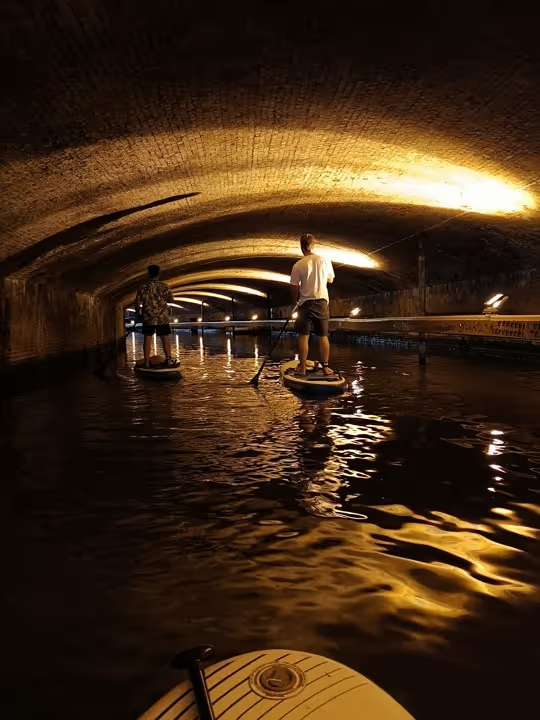
Sustainable tourism has received more and more attention in recent years. Cities around the world are looking for new ways to offer environmentally friendly recreational opportunities to both their residents and tourists. Water recreation, such as kayaking and stand-up paddleboarding (SUP), is therefore playing an increasingly important role in this. Both activities not only promote a healthy lifestyle, but also strengthen the link between cities and their waterways.
In this article, we take a look at a number of inspiring examples of cities that go very far in this trend. And we also check how our own Flemish cities are doing.
The most progressive cities in water recreation
Gothenburg
An inspiring example of sustainable tourism is undoubtedly the city. Gothenburg in Sweden. The city has already been awarded as the world's most sustainable destination, and that's quite right, as far as we're concerned.
Gothenburg is completely reintegrating its waterways into city life with initiatives such as “RiverCity Gothenburg” that repurpose no less than 5 million m² of riverbed and old shipyards. This is immediately the largest redevelopment project in all of Scandinavia. In the margins of this huge project, there is also a focus on water recreation, allowing both residents and tourists to (re) discover the city from the Göte River.

Valencia
Also in Valencia The relationship with water has been completely revised; for example, the former Turia riverbed has been transformed into a green vein of no less than 9 kilometers long that runs right through the city from the coast. It has become a series of green areas, culture and recreation.
Today, the Jardín del Turia offers plenty of opportunities for outdoor activities such as cycling, hiking and skating, but there is also a focus on water recreation, especially around the Ciudad de las artes y las ciencias, with the famous ultra-modern buildings designed by Calatrava.

Dobber: sustainable water recreation in Flanders
In Flanders, too, we are not standing still when it comes to sustainable tourism. In the meantime, this has also meant that we have had opportunities in several cities with Dobber. Let's zoom in on Mechelen, Kortrijk, Ghent and Turnhout.
Mechelen: green zones on the Dyle
So put Mechelen major steps in redefining its relationship with the Dyle River that crosses the city. The city is committed to promoting biodiversity and creating green urban spaces along the waterways, of which the Botanical Garden is the most important example. You can discover it all for yourself during the kayaking in Mechelen with start and arrival at the Keerdok.

Kortrijk: upgrading the Leieboorden
In Kortrijk The banks of the Leie, on the other hand, received a radical makeover, for example, the Buda Island near the Broel Towers has become one of the city's hotspots today.
The Albert Park area between the ultra-modern Groeningebrug and Collegebrug is also a vibrant green area today. You'll discover it all during the kayaking around Buda Island.

Ghent: repurposing the old port infrastructure
And of course, we shouldn't forget to mention our home base in Ghent either. The city is fully committed to sustainable water recreation. A perfect illustration of this can be found at Dobber Keizerpoort on the French Canal. But Portus Ganda, the Fisheries and Dok-Noord are also being fully transformed into bustling river neighborhoods.

Turnhout: new life on the Nieuwe Kaai
In the meantime, Dobber has also been given a place at the Nieuwe Kaai in Turnhout. It's all part of the city's ambitious plans, which wants to fully focus on a contemporary tourist experience. And you notice that not only in the bustling city center, where you can find a very harmonious combination of old and modern architecture, but now also on the water. From Turnhout Float on the Nieuwe Kaai you'll explore the city in a different way, but with our kayak and SUP routes to the Baalse Hei whether the Looibos you can also discover the rural surroundings just outside the city ring.

Want to play sustainable water tourism in your own country? Reserve a SUP or kayak with Dobber and have an unforgettable day on the water!
€5 korting op je eerste sessie?
Schrijf je in op onze nieuwsbrief en mis geen enkel nieuwtje of promotie!


